This is the
song we are listening to remember materials. Here, you can see our students singing
it.
Mostrando entradas con la etiqueta Science. Mostrar todas las entradas
Mostrando entradas con la etiqueta Science. Mostrar todas las entradas
martes, 1 de mayo de 2018

domingo, 29 de abril de 2018
TEXTURES AND PROPERTIES OF MATERIALS
As you know,
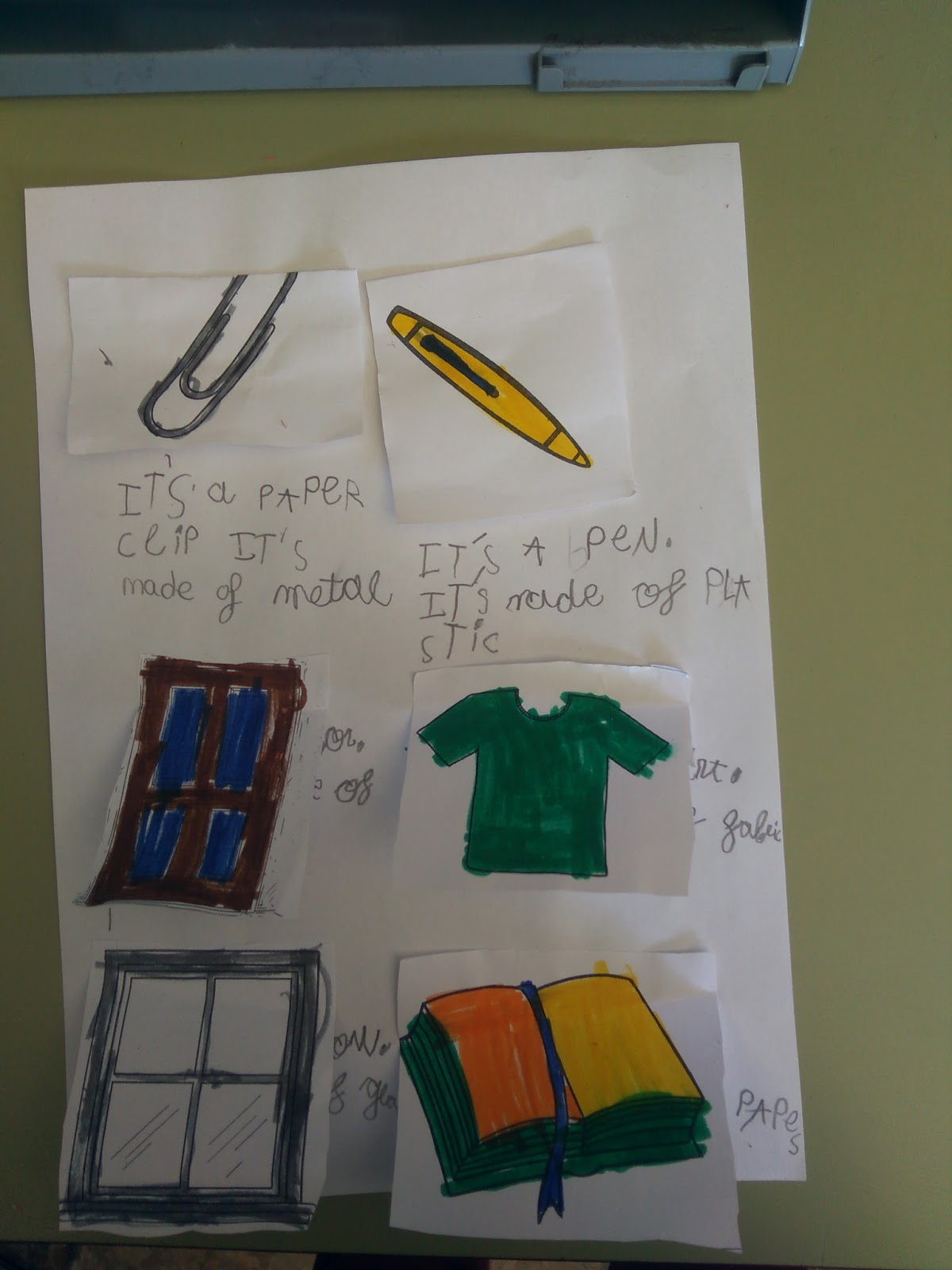
we are working on materials and properties of materials in Science. This week
we made this book to remember them and also for being able to recognize and differentiate
them.


viernes, 20 de abril de 2018
MATERIALS
Hello everybody!
In Science,
we are learning about materials in unit 5. Our students must learn the names of
the following materials: wood, plastic, glass, metal, fabric and paper.
They have
to learn the properties of materials, too. These are: hard/soft, smooth/rough,
rigid/flexible, transparent/opaque.
This week, we have been working on them. They
have colored and cut some pictures of different objects to describe them. These
are some of their works.
¡Hola a todos!
En Ciencias de la Naturaleza estamos aprendiendo los
materiales en la unidad 5. Nuestros niños deben aprender los nombres de los
siguientes materiales: madera, plástico, cristal, metal, tela y papel.
También tienen que
aprender las propiedades de los materiales. Son: duro/blando, liso/rugoso,
rígido/flexible, transparente/opaco.
Esta semana, hemos estado trabajando en esto. Han coloreado
y cortado algunos dibujos de diferentes objetos para describirlos. Estos son
algunos de sus trabajos.




They also
have described some classroom objects, as you can see in the video.
-----
También han descrito algunos objetos de a clase, como podéis
ver en el vídeo.


This is the
song we are listening to remember them better.
----
Esta es la canción que estamos escuchando para recordarlos
mejor.
GAMES
lunes, 19 de marzo de 2018
ANIMALS 2ND TERM
Here is the 'study sheet' and the 'Reading sheet' of the second term.
STUDY SHEET


HOJA DE LECTURA

VERTEBRATE AND INVERTEBRATE ANIMALS
We also have been learning about the differences between vertebrate and invertebrate animals.
- Vertebrate animals have a skeleton.
- Invertebrate animals don't have a skeleton.
---------------------
También hemos estado aprendiendo sobre las diferencias entre los animales vertebrados e invertebrados.
- Los animales vertebrados tienen esqueleto.
- Los animales invertebrados no tienen esqueleto.
- Los animales vertebrados tienen esqueleto.
- Los animales invertebrados no tienen esqueleto.
To reinforce these contents we made the following sheets:
----------------
Para reforzar estos contenidos hicimos las siguientes fichas:

A tiger is a vertebrate animal. It has a skeleton.

A starfish is an invertebrate animal. It doesn't have a skeleton.

We also talked about dinosaurs. They were reptiles and they were vertebrate animals. Some of them were carnivore with sharped teeth and other dinosaurs were herbivore with rounded teeth. Hakim brought to our classroom the skeleton of one of his toys.
----------------
También hablamos sobre dinosaurios. Eran reptiles y eran animales vertebrados. Algunos de ellos eran carnívoros con dientes afilados y otros dinosaurios eran herbívoros con dientes redondeados. Hakim trajo a nuestra clase el esqueleto de uno de sus juguetes.
INVESTIGATION OF BUGS
As we have been learning about insects, we investigated about them.
Characteristics of insects are the following ones:
- They are invertebrate animals.
- They have head, thorax and abdomen.
- Some have wings and some can fly.
- They have two antennae and six legs.
We observed some bugs and we found the only one in the sheet that it wasn't an insect.
--------------------
Como hemos estado aprendiendo sobre los insectos, investigamos sobre ellos.
Las características de los insectos son las siguientes:
-Son animales invertebrados.
-Tienen cabeza, tórax y abdomen.
-Algunos tienen alas y otros pueden volar.
-Tienen dos antenas y seis patas.
Observamos algunos bichos y encontramos el único de la ficha que no era un insecto.


domingo, 18 de febrero de 2018
OVIPAROUS AND VIVIPAROUS ANIMALS
Here, you can watch some videos and listen to several songs about oviparous and viviparous animals. Then, you can practice playing some of the following games. Enjoy it!

VIDEOS
REMEMBER! There are some fish that are not oviparous animals, like sharks, whales or dolphins. There is another exception in birds, as for example, BATS.
martes, 13 de febrero de 2018
ANIMALS SCIENCE 1
In this unit we are learning about animals. We have been learning what animals eat and their names of that classification: herbivores, carnivores and omnivores.
We played with these puzzles to reinforce the learnt content.
------------------------
En esta unidad estamos aprendiendo sobre los animales. Hemos estado aprendiendo qué comen los animales y los nombres de esa clasificación: herbívoros, carnívoros y omnívoros.
Jugamos con estos puzles para reforzar lo aprendido.


Then, we also played to build sentences related to the topic.
------------
Luego, también jugamos a construir frases relacionadas con el tema.


Suscribirse a:
Entradas (Atom)